
Reflections from our work with more than 1,000 summer learning sites on the questions Superintendents, School Boards, and funders care most about.
At the end of a summer learning program, leaders are often asked a deceptively simple question: Did it work?
In many cases, they have plenty of information to share. They can report how many students enrolled, how often they attended, and how their assessment scores changed from the beginning to the end of the summer.
But those results can raise as many questions as they answer.
A program might report strong average academic gains, while some students made considerably less progress than others. Attendance might look healthy overall, even though participation declined sharply during the final weeks. Students might show growth on an assessment, but educators may still be unsure which concepts students have mastered and where they'll need additional instruction in the fall.
Through our work with more than 1,000 summer learning sites across the country, we've seen that the challenge often isn't a lack of data. It's bringing those results together to tell a cohesive, compelling story about the impact of summer programming, how well we're meeting our ambitious goals for students, and where we can improve.
During our recent webinar, Can You Prove Your Summer Program Worked?, we explored three questions that help leaders evaluate their programs and communicate results to superintendents, school boards, and funders:
- Engagement: Were students consistently engaged?
- Impact: What was the impact on student learning?
- Equity: Was our program equitable?
We discussed metrics and reporting strategies to answer these questions, drawing on results from our summer learning partnerships and practical examples from the field. We also welcomed David Woods and Janelle Dennis from Enjoy Detroit, who shared how their team uses student and family feedback to strengthen participation and continuously improve their program.
In our webinar, Can You Prove Your Summer Program Worked?, we shared findings from our Summer RISE partnerships, explored assessment reporting tools, and heard from Enjoy Detroit about how they supported student participation.
Engagement: Did Students Show Up, Participate, and Stay Engaged?
Summer learning programs operate within a short instructional window. Students may be balancing family schedules, transportation challenges, and other commitments. Missing even a few days can mean missing a substantial portion of the planned instruction.
That's why we start by examining engagement.
How many students enrolled, and how many attended consistently? Did participation change throughout the summer? Were students engaged in the activities and learning experiences offered? And what did students and families tell us about their experiences?
Attendance data provides an important starting point, but it doesn't tell the whole story.
Our conversation with David Woods and Janelle Dennis from Enjoy Detroit offered a valuable example of what happens when program leaders look beyond the numbers.
Their team had been communicating with families through mass emails and text messages, but they weren't always getting the responses they needed. They began making individual calls, sending personal messages, and visiting families.
Through those conversations, they learned about transportation challenges and adjusted bus routes to help students participate more consistently.
They also listened when students expressed interest in greater flexibility in their enrichment activities. Rather than requiring students to remain in the activities they'd selected during registration, Enjoy Detroit introduced daily sign-ups.
These examples show why engagement data is especially useful when paired with feedback from those experiencing the program.
Attendance records can tell us where participation is declining. Conversations with students and families can help us understand what's contributing to those patterns and what we might do differently.
And the sooner we identify those challenges, the more opportunities we have to respond while students are still in the program.
Engagement also gives us essential context for interpreting academic outcomes. If only a subset of enrolled students attended consistently, their academic gains may not reflect the entire group's experience.
That brings us to our second question: What did students actually learn?
Impact: Academic Growth Is the North Star. What Can We Learn From It?
For academic summer programs, one of our most critical questions is whether students learned what the program set out to teach.
Pre- and post-assessment results let us examine that progress, especially when the assessments align with the curriculum students experienced.
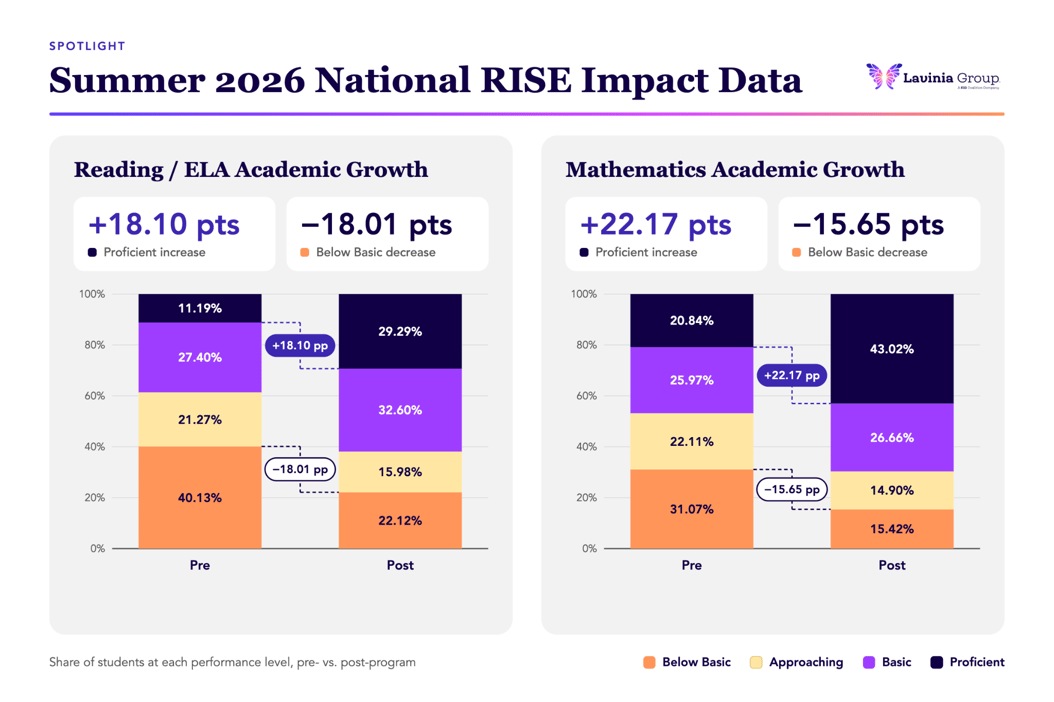
Across our Summer RISE partnerships in 2026, we saw encouraging results. The percentage of students scoring proficient in English language arts increased by 18 percentage points, while the percentage scoring below basic decreased by 18 percentage points. In math, the percentage of students scoring proficient increased by 22 percentage points.
These are important results to examine. They show movement across performance levels over the summer.
But when we're reviewing results with program leaders, we also want to understand what's happening within those overall figures.
How much progress did students make from different starting points? Which grade levels demonstrated the strongest gains? Did students across different sites experience similar results? Which standards were students still struggling with at the end of the program?
Consider a group of students whose overall math scores improved, but whose responses show continued difficulty explaining why an addition or subtraction strategy works using place value.
That tells us something useful about their learning. They may be able to carry out a procedure more successfully than they can explain the mathematical reasoning behind it.
If we can identify that pattern in the assessment results, we can return to the curriculum, examine how the concept was taught, and consider what students will need next.
During the webinar, we walked through how Summer RISE partners can use assessment dashboards to examine results by program, grade, classroom, student, and standard.
Program-wide results help leaders communicate students' academic progress. More detailed results help educators decide how to use that information.
And as students return to school, those instructional decisions become especially important.
Strong Overall Results Can Hide Differences Across Student Groups
The third area we explored during the webinar was equity.
This is where looking carefully at both academic results and participation becomes especially useful.
Suppose a program reports substantial academic growth overall. That's encouraging. But what happens when we look at the results by grade level, student group, or program site?
Are the gains consistent? Are there groups of students who attended regularly but made less academic progress? Are there students whose participation was limited by transportation, scheduling, or other barriers?
We can't answer those questions from a single program-wide average.
And we shouldn't assume that differences in outcomes have a simple explanation.
A group of students may have started the summer with different academic needs. They may have had different attendance levels. They may have had access to different instructional conditions.
Disaggregating the data helps us identify where we need to look more closely.
For example, if one site shows lower attendance and smaller academic gains, we would want to examine both patterns before drawing conclusions. We might review attendance week by week, speak with site leaders, and examine assessment results by grade and standard.
That process helps us better understand students' experiences.
The Enjoy Detroit transportation example is relevant here, too. By listening to families, the team identified a barrier to participation that an academic report might not have shown.
When we evaluate whether a summer program was equitable, we want to understand who could access it, who participated consistently, and how students progressed academically.
What Should Happen After the Final Summer Report?
One challenge is that educators often review summer learning data as they prepare for a new school year.
The final assessment report is completed. Attendance is summarized. A presentation is prepared for leadership or funders.
Then attention shifts to the fall.
But those summer results contain valuable instructional information.
If students made strong progress on certain standards but continued to struggle with others, teachers can use that information to plan instruction. If particular grade levels or classrooms showed stronger gains, program leaders can examine what those educators did. If attendance patterns revealed barriers for families, that can inform decisions about next summer's schedule, transportation, and communication.
This is also where the three areas we discussed, engagement, impact, and equity, help with planning.
Academic results tell us where students made progress. Engagement data helps us understand how consistently students participated in the instruction. Looking across student groups helps us identify differences that warrant closer examination.
We can then ask more precise questions about the program.
Which parts of the curriculum were especially effective? Where did students need more time? Which participation barriers were addressed successfully? What should we change before next summer?
Those are the questions we hope leaders are asking as they review this year's results.
Demonstrating that a program worked is an important responsibility. Understanding what contributed to the results, and what we can learn from them, is how we make that evaluation useful for students.
Let's Talk About Your Summer Learning Program
Whether you're building a summer learning program from the ground up or looking to strengthen an existing one, we'd love to hear what you're planning.
At Lavinia Group, we work with schools and organizations to design summer programs with strong academic instruction, meaningful enrichment, and a clear approach to understanding student progress.
Connect with us to talk about your goals for next summer and how we can support your program.
Key Takeaways From the Webinar
- Start with academic results. Examine pre- and post-assessment performance, movement between proficiency bands, and student progress on specific standards.
- Review attendance alongside achievement. Participation patterns provide important context for interpreting academic results.
- Look beyond program-wide averages. Disaggregate engagement and academic data to identify differences across student groups, grades, and sites.
- Listen to students and families. Their feedback can help explain participation patterns and identify changes a program can make.
- Use the results for instructional planning. Summer assessment data can inform what teachers do when students return to school.
Frequently Asked Questions About Summer Learning Evaluation
How do you measure the effectiveness of a summer learning program?
We recommend examining academic growth, student engagement, and equity together. Pre- and post-assessment results show how student performance changed, while attendance and student and family feedback help explain the conditions in which that learning took place.
What academic data should summer learning programs report?
Programs can report changes in assessment performance, the percentage of students moving into proficiency, the percentage moving out of lower performance bands, and results by grade level or standard. These measures provide different views of students' academic progress.
Why should summer learning programs analyze attendance alongside achievement?
Attendance shows how consistently students accessed the planned instruction. Reviewing attendance and achievement together can help leaders identify participation patterns that may help explain academic results.
How can leaders evaluate equity in a summer learning program?
Leaders can examine enrollment, attendance, and academic outcomes across student groups and sites. They can also gather family feedback to identify barriers that may have affected participation.
How can summer assessment data inform the school year?
Student-level and standards-level results can help teachers identify strengths and concepts that need additional instruction. Program leaders can also use the results to review curriculum implementation and plan future summer programming.
About the Webinar Hosts
Kate Glover
Managing Director, Partnerships | Lavinia Group
Kate is a Managing Director at Lavinia Group, where she manages a portfolio of partnerships and project teams working toward ambitious goals for teaching and learning. Kate brings expertise in academic improvement strategy, with specialized expertise in high-quality instructional materials and literacy research and practice. Prior to her work at Lavinia Group, she spent 13 years at TNTP where she advised 50+ SEA and district partners in the identification of clear academic priorities and development of a coherent instructional improvement strategy, including the implementation of coherent support for struggling students. Kate received a Master of Arts in Urban Education Policy from Brown University and a Bachelor of Arts in Political Science and Journalism from the University of Richmond.
Blake Obi, M.Ed.
Associate Director of Summer Learning Programs | Lavinia Group
Blake Obi is an instructional leader who works with schools and summer learning partners to strengthen academic programming. At Lavinia Group, he helps educators connect curriculum, assessment, and instructional planning so students can use what they learn during the summer to inform their transition into the school year.